Issue #16: Ignatian Spirituality
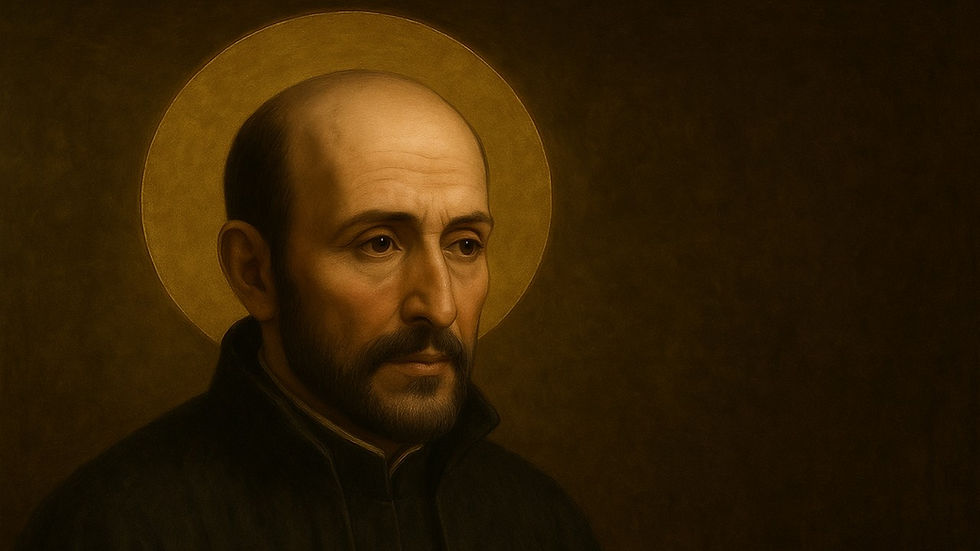
You have probably heard of the Jesuits, or seen the movie The Mission (1986), and more recently, Silence (2016), directed by Martin Scorsese. The Jesuits were formerly known as the Society of Jesus. They are a Roman Catholic religious order founded in 1540 by Saint Ignatius of Loyola. Ignatius (1491–1556) was born the youngest of thirteen children in the Basque region of Navarre. He began life as a nobleman, soldier, and self-described party animal who enjoyed chivalry and the excesses of court living.[1]
The Life and Transformation of Ignatius of Loyola
Saint Ignatius’s spiritual transformation began after he was wounded during a battle between two factions. Liebert recounts that a cannonball struck him, shattering the bones of his right leg and wounding the left. He was carried back to his home to recover. This was a long season of recovery, and he was faced with the reality that his days as a courtier had ended. He also underwent multiple operations, which in those days would have been very traumatic and painful. Once he began to feel a little better, he requested some books, hoping to read on chivalry. The house where he was staying, however, only had two books: “The Life of Christ” by the Carthusian author Ludolph of Saxony and the “Lives of the Saints (The Golden Legend)” translated by Jacques de Voragine. These were not the kind of books that he was hoping to read.[2] Nevertheless, he read them several times and was profoundly moved by them.[3] Ignatius “began to pay closer attention to the dynamics of these movements in his mind and heart, and soon realized that while his passion for the exploits of courtly love would fade quickly, his excitement about the possibility of being a saint tended to stay with him much longer,” says Mossa.[4] It was in this time of tremendous physical pain, boredom, and suffering that he sought the will of God and began his journey of discerning his vocation. This is true of many of us today, who turn to God, and we find ourselves in a place where we need God.
Liebert explains that once Ignatius was in better health and had gained some strength, he became a pilgrim and laid down his sword in Montserrat, his first stop on his journey to Jerusalem. He wished to go to the Holy City, but on his way, he had an extended stay in Manresa, which became a place of profound spiritual formation and intense growth. It was during this time that he struggled with serious self-doubt about the state of his soul, grew in common sense, developed his preaching and pastoral abilities, and placed himself under the guidance of a spiritual director.[5]
Ignatius’s conversion led to intense mystical experiences that included visions of the Trinity, says Eire, especially while he lived in a cave in Manresa. He had no theological training, and his unconventional religious counselling in Spain drew suspicion from the Inquisition, who associated him with the alumbrados, which were a sect that believed in moral perfection through divine closeness.[6]
The Founding of the Jesuits: A New Kind of Religious Order
The outline of Ignatius’s “Spiritual Exercises” was penned by 1524, but as he gained experience, he would revise his manuscript over the next twenty-four years.[7] During these years, Ignatius filled in the gaps of his education, says Liebert. He explains that he continued to preach, though only in the bounds set by the Inquisition. He later began studying in Paris. It was here that he gathered to himself a small group of men who would become the Society of Jesus, also called the Jesuits. These men were students at the University of Paris. The last two decades of his life were spent in Rome, where he managed the Society of Jesus, which was growing quickly. Here Ignatius wrote the order’s constitution, his autobiography, and copious amounts of personal correspondence.[8] Taking into account only his letters, Ignatius is said to be the most prolific writer of his day.[9]
I’ve already mentioned Ignatius’s “Spiritual Exercises,” which are like a manual for the director who gives a retreat.[10] It’s not meant to be read straight through, though I confess I’ve done that twice to get a sense of its content; I don’t recommend you do that; you will probably get much more out of reading his autobiography. Be that as it may, many people have benefited working through the “Spiritual Exercises” under the direction of a spiritual director who is specially trained to guide you through the exercises—people say it’s a life-changing experience.[11]
It should be noted that the Spiritual Exercises were not a work of innovation, says Liebert. But Ignatius did develop a new synthesis of selected pieces of Christian Spirituality that existed before him. For example, it reorders the lectio divina practice that was an important part of Benedictine spirituality. Ignatius’s synthesis offers an ascetic and practical spirituality for the everyday person that is “oriented to mission in the world.”[12]
The Global Mission of the Jesuits
The Jesuits also reached the Far East, initially through the work of Saint Francis Xavier (1506–1552) was an early Jesuit missionary who opened missions in India and Japan and attempted to reach China (he died on the island of Shangchuan off the Chinese coast). Alessandro Valignano (1539–1606) and Matteo Ricci (1552–1610), among others, also played significant roles in making inroads into the Far East, although this mission was not without controversy. The Jesuit mission also reached South America. Silence is a 2016 epic historical drama film that follows two Portuguese Jesuit priests who travel to 17th-century Japan in search of their missing mentor. There, they witness the brutal persecution of Christians and struggle with questions of faith, apostasy, and God’s seeming silence in the face of suffering. The movie is well worth watching! The involvement of the Jesuit order and its spirituality in the 20th and 21st centuries, Latin America, has also been controversial, especially with its focus on Liberation Theology, drawing on various Marxist concepts when engaging in social justice. (The Christian Mysticism Podcast 2024)
The Spiritual Exercises and the Ignatian Examen
Liebert explains that all Jesuits, that is, the members of the Society of Jesus, are formed by Ignatius’s Spiritual Exercises. The Constitutions of the Jesuit order weave together personal spirituality with corporate spirituality. The Jesuits were and are religious men who are trained in secular occupations alongside the laity. This “apostolic religious life changed the face of Christianity in the West by creating an enormous network of ministries,” proclaims Liebert.[13] The Jesuits are known to be teachers and innovative educators, even though Saint Ignatius was not himself naturally inclined towards academia, and one might even say he was sometimes anti-intellectual, according to Mossa.[14] He explains the differences between the Jesuits and the other religious orders as follows:
All religious communities up until this point required that its members gather regularly throughout the day for communal prayer. Ignatius’s vision, however, was of a community whose priority would be its ministry, ministry that would make irregular and different demands of individual members of the community. The model of Jesuit community would come to be known as one of contemplatives in action, each priest and brother required to attend mass and engage in daily prayer, but according to a schedule dictated by his ministry rather than at mandated times.[15]
Nevertheless, the Spiritual Exercises have proved to be profoundly influential even in modern-day spiritual direction and religious retreats, in both Roman Catholic and Protestant churches.[16] It is a systematic guide for self-examination and spiritual growth and is structured around the traditional spiritual themes of purgation, illumination, and union with God. The practices include imagining oneself in the gospel scenes and engaging with one’s senses in a meditative manner. Although it’s grounded in 16th-century piety, it’s not dissimilar to modern psychological introspection, although the aim is to discern God’s purpose in one’s life. (The Christian Mysticism Podcast 2024)
The Jesuits have updated their founding documents, the Spiritual Exercises, and practices in response to Vatican II, which has made Ignatius’s teachings more accessible to a broader context. This is especially true in the advent of the internet. There are possibly more non-Jesuits these days who teach the Spiritual Exercises.[17] Liebert says it well when he says, “As any dynamic spiritual text must, the Spiritual Exercises has transcended its origins and now belongs to the living spiritual heritage of the whole church.”[18] The Spiritual Exercises are divided into four weeks, although they are often taught during an intense residential retreat over four weeks; they need not be literal weeks. They could be shortened to 8 days, for example, or stretched out or spread over 30 or more weeks for those who are unable to take off a full month for such a retreat.
These “weeks” help focus one’s life on their personal relationship with God. It begins by highlighting one’s own sinfulness and focuses on Jesus Christ, namely his life, passion, death, and resurrection. The prayers are generally taken from scripture, and the devotions from Christian tradition.[19] The four weeks are as follows:
Week 1: Knowing oneself as a redeemed sinner
Week 2: Invitation to discipleship
Week 3: Participating in Christ’s passion
Week 4: Finding God in all things[20]
Among other parts of the Ignatian Spiritual Exercises, it includes:
Colloquy: This is a conversation with God as one might converse with a friend.
Meditation: This is “prayerful consideration of a religious mystery, event, or passage from scripture.”
Contemplation: Ignatius offers a unique take on contemplation by suggesting the use of imagination in prayer, imagining what it might be like to be in one of the gospel scenes.
The Examen: This is a wonderful little exercise that is a part of the Spiritual Exercises, but can also be done daily outside the four weeks. It is a daily review of one’s day, a short spiritual exercise of reflection. At this time, you take a brief inventory of your sins and mistakes, honestly acknowledging where you may have fallen short. This is accompanied by repentance, turning back to God with sincerity. You also become more aware of God’s presence with you throughout the day. Part of this awareness is learning to notice the many ways He has been at work, both great and small. Gratitude plays an important role here. You pause to give thanks for special moments or gifts you received. These do not need to be extraordinary events. It could be something as simple as a delicious cup of coffee in the morning, a meaningful conversation with a friend, a kind word spoken, or the beauty of a sunset. Through this practice, you train your heart to see God’s hand in all things and to respond with both repentance and thanksgiving.[21]
Task
The Jesuit priest, Fr. Mark Thibodeaux, SJ, provides us with a helpful guide for practising the Ignatian Examen. I suggest doing it once or twice a day for five or ten minutes, and feel free to adapt and modify it to your own life, as Thibodeaux does in his book, Reimagining the Ignatian Examen: Fresh Ways to Pray from Your Day. But here is the standard practice to get you started.
How do you do the Examen:
Give thanks.
Ask for the Spirit.
Review and recognize failures.
Ask for forgiveness and healing.
Pray about the next day.
To help you remember the five steps, I like to use a 5-Rs mnemonic:
Relish the moments that went well and all the gifts I have today.
Request the Spirit to lead me through my review of the day.
Review the day.
Repent of any mistakes or failures.
Resolve, in concrete ways, to live tomorrow well.[22]
The strength of Ignatian Spirituality is its synthesis of action and contemplation, and its adaptability for the laity. In recent years, it has also enjoyed a welcome reception among certain Protestant traditions who have benefited greatly from the Ignatian Spiritual Exercises, whether it be the entire four weeks or the Ignatian Examen.
You might also be interested in reading the autobiography of St. Ignatius, freely available here.
AI Disclaimer:
This blog has been edited for grammar, clarity, and readability using AI-assisted tools. The core content, theological insights, and personal reflections remain my original work.
[1] St. Ignatius of Loyola: The Nobleman and Soldier Who Became a Mystic, directed by The Christian Mysticism Podcast, 51:51, 2024, https://www.youtube.com/watch?v=973Y8oMeBUo; George A. Lindbeck, The Nature of Doctrine: Religion and Theology in a Postliberal Age, 25th Anniversary Edition (Westminster John Knox Press, 2009), Ch. 17.
[2] Elizabeth Liebert, “IGNATIUS OF LOYOLA (1491–1556): The Spiritual Exercises,” in Christian Spirituality: The Classics, ed. Arthur Holder (Routledge, 2009), Ch. 17; Ignatius: The Nobleman and Soldier.
[3] Liebert, “Ignatius of Loyola,” Ch. 17.
[4] Mark Mossa, Saint Ignatius Loyola―The Spiritual Writings: Selections Annotated & Explained (SkyLight Paths, 2012), Introduction.
[5] Liebert, “Ignatius of Loyola,” Ch. 17.
[6] Ignatius: The Nobleman and Soldier.
[7] Liebert, “Ignatius of Loyola,” Ch. 17.
[8] Liebert, “Ignatius of Loyola,” Ch. 17.
[9] Mossa, Saint Ignatius Loyola―The Spiritual Writings, Introduction.
[10] Mossa, Saint Ignatius Loyola―The Spiritual Writings, Introduction.
[11] Liebert, “Ignatius of Loyola,” Ch. 17.
[12] Liebert, “Ignatius of Loyola,” Ch. 17.
[13] Liebert, “Ignatius of Loyola,” Ch. 17.
[14] Mossa, Saint Ignatius Loyola―The Spiritual Writings, Introduction.
[15] Mossa, Saint Ignatius Loyola―The Spiritual Writings, Introduction.
[16] Liebert, “Ignatius of Loyola,” Ch. 17.
[17] Liebert, “Ignatius of Loyola,” Ch. 17.
[18] Liebert, “Ignatius of Loyola,” Ch. 17.
[19] Mossa, Saint Ignatius Loyola―The Spiritual Writings, Introduction.
[20] Liebert, “Ignatius of Loyola,” Ch. 17.
[21] Mossa, Saint Ignatius Loyola―The Spiritual Writings, Introduction.
[22] Mark E. Thibodeaux, Reimagining the Ignatian Examen: Fresh Ways to Pray from Your Day (Loyola Press, 2015), x–xi.


Comments